
St Peter and Holy Cross church, Wherwell

Each image is linked to a larger version; to see the larger version it may be necessary to allow ‘pop-ups’.
Most of the fabric of the present church is mid-nineteenth century in date, although traces of the earlier medieval structure still survive, and a collection of early architectural fragments, probably from the priory church, are displayed in the north aisle. These include a Saxon cross-shaft, two late 13th century carved stone reliefs, a pier base bearing the name Tho(ma)s Beow, and fragments from a stone coffin. There is also the recumbent effigy of a nun, originating from the priory church but more lately moved from a niche in the churchyard wall, once thought to represent the Abbess Euphemia but now tentatively identified as Juliana Overey. The original aim of the survey was to examine these earlier fragments for historical graffiti, and to look for any surviving medieval fragments preserved within the church fabric or its surrounding walls.
 |
Rather disappointingly the only graffiti we found on the pre-Reformation stonework inside the church was a cross and some masons marking out lines on the pier base. On the tomb of Sir Owen West, died 1551, also in the NW corner of the N aisle, was an incised cross and some faint initials, P or RS (see left). |
 |
History Group members pointed out the 1858 Iremonger mausoleum (see left) in the churchyard, which incorporates some impressive Romanesque monster heads, and some medieval shields. Sadly, we found no graffiti on the mausoleum stonework. |
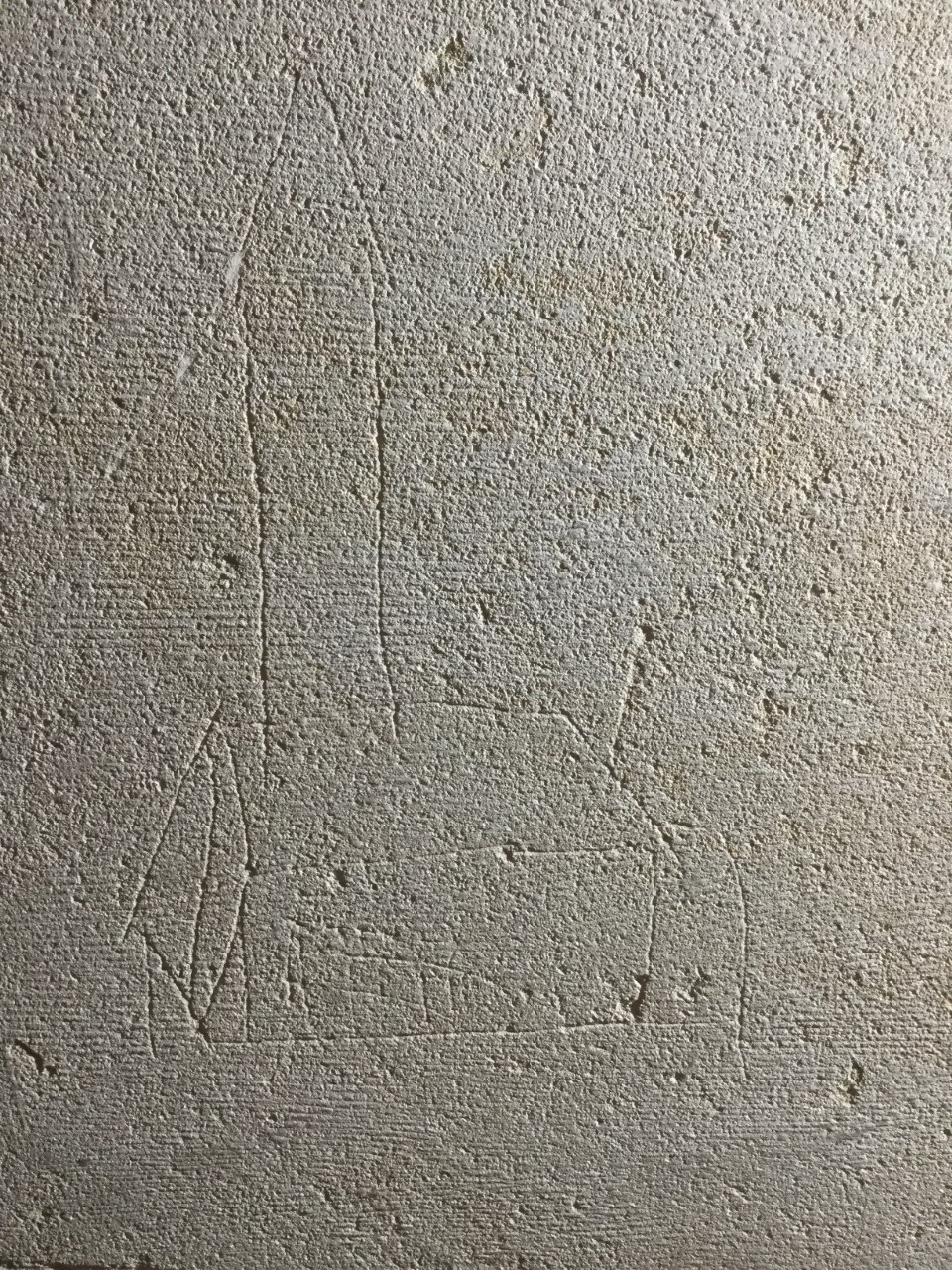
On the interior church fabric the most striking and unusual graffito was the carefully incised drawing of a church building with tall tower – Photo 4 below. This was on the west-facing wall of the passageway between the vestry and chancel. What building it represents is unknown, but it does not seem to be this church. Some geometric shapes, crosses and patterns were found on the sill of window; one may be an elaborate VV pattern – Photo 5 below. These were originally invocations to the Virgin Mary, VV standing for Virgo Virginum, Virgin of the Virgins, but post-Reformation they were used more generally as apotropaic symbols, protecting against evil.
 |
 |
|
| Photo 4 | Photo 5 |
The most productive areas for graffiti were the wooden organ casing and the pews. One was Denis Harding who carefully carved his name on 1st July 1939 – Photo 6. Sadly this gentleman had only died a short time before our first visit, so would have been about 12 when he left his mark. Some people whiled away their time listing animals, or left lists of dates or references to the order of service. Others dreamt of racing cars – Photo 7 – or drew caricatures – Photo 8.
 |
 |
 |
||
| Photo 6 | Photo 7 | Photo 8 |
The pews, which must be part of the original fittings of the church, dating to mid nineteenth century, provided a wealth of interesting graffiti. There is palimpsest of names and patterns on – Photo 9 – which appeared to be 19th century in date stylistically. There are glimpses into everyday life, including some charming depictions of ladies lace-up boots – Photo 10, and a surprising number of sailing ships – Photo 11.
 |
 |
 |
||
| Photo 9 | Photo 10 | Photo 11 |
On the church exterior only one graffito was noted: a cross on the north wall. The Ordnance Survey benchmark on the SE corner of the S aisle was recorded.
Acknowledgements
A team from the Hampshire Medieval Graffiti Project visited the church on 13th July and 14th September 2019. We were welcomed by members of the Wherwell History Group who kindly provided much useful background information about the history of the church, and of the adjacent priory site, helping us to put the site into context. Special thanks go to Andrew Flanagan who helped arrange our visits and provide access to the belfry and to the end of the south aisle. We would also like to thank David Etchells for the introduction to the churchs history and copies of articles, and all the kind folk who made us so welcome, providing refreshments and the benefit of their knowledge and enthusiasm for this historic building.
The full report is available as a PDF download (0.4 mb).
Karen Wardley, Co-ordinator, HMGP, October 2019