7 April 1858 – 20 December 1943
Williams-Freeman was born at Hamble Cliff, Southampton, the youngest of three sons. He attended Haileybury College and looked set to follow his eldest brother into the Army. At Woolwich, however, he changed direction and opted for the medical profession, graduating from Durham in 1885 and obtaining the Gold Medal in his MD exam three years later.
In 1889 he arrived at Weyhill, in the north of the county, as a country doctor, and served in that capacity until his retirement in 1928. His interest in archaeology was fired by Percy Farrar of Thruxton and by the Wiltshire Cunningtons. He realised that if all the earthworks of the county were properly surveyed and described it would be a solid foundation from which to work. The result was Field Archaeology as Illustrated by Hampshire (1915) one of the most seminal publications of the developing subject.
His interests also embraced the new science of aerial photography, where he liaised with OGS Crawford, and many other subjects. Perhaps his greatest strength lay in communicating his love of history and archaeology to a wide audience. He joined the HFC in 1906 and served it in several capacities. In the tributes following his death he was referred to as ‘the Father of the Field Club’, such was his influence in turning a learned society, the preserve of a few scientific minds, into an organisation that brought enjoyment to many.
In 1897, Williams-Freeman married Mabel Christiana Napier and they had four daughters. According to his wife this redoubtable team, along with relatives and friends, spent all their spare time ‘swept into the service of measuring rod and tape’ as his magnum opus was compiled. Williams-Freeman is buried in Weyhill Churchyard.
Sources
- Hants Field Club
Portrait
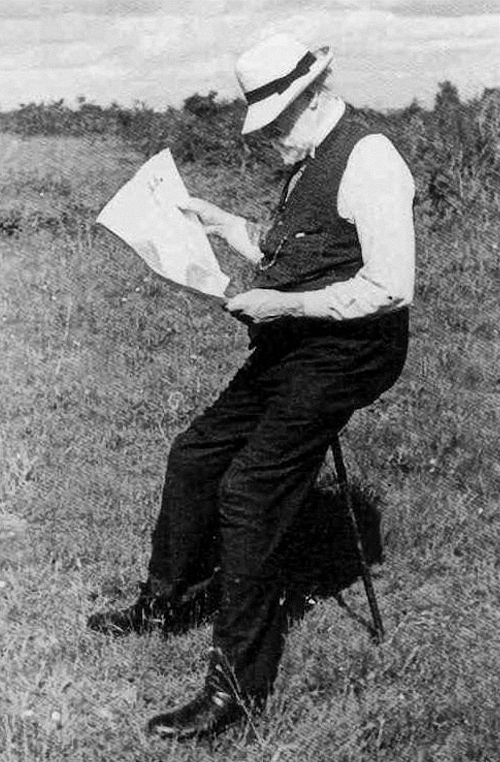
Contribution to county’s history
Williams-Freeman was a central figure in the Hampshire Field Club for more than thirty years and broadened its horizons immeasurably. His seminal work ‘Field Archaeology as Illustrated by Hampshire’ broke new ground and included much more than a gazetteer of sites, encompassing local history, folk lore and place name studies.
Relevant published works
-
Danebury,Proc Hants Field Club & Archaeol Soc, 6 pp 293-308 (1910)
-
Notes on Roman roads in the south of Hants,Proc Hants Field Club & Archaeol Soc, 7 pp 34-42 (1914)
-
An Introduction to Field Archaeology as Illustrated by Hampshire, Macmillan & Co. London, 1915.
-
Short cross-valley dykes,Proc Hants Field Club & Archaeol Soc, 13 pp 55-60 (1935)
- The Earliest Archaeology, Proc Hants Field Club & Archaeol Soc, 15 pp 152-158 (1942)
- Early days of the Field Club, Proc Hants Field Club & Archaeol Soc, 15 pp 236-244 (1943)
Critical Comments
Other Comments
Contributor
Dave Allen 2 August 2021
Key Words
Hampshire Field Club, Weyhill, Field Archaeology
If you are able to add anything to this entry, please send your ideas to celebrating@hantsfieldclub.org.uk.