
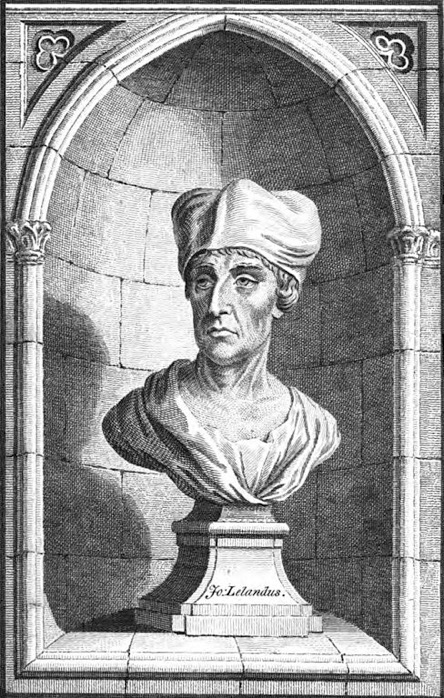
13 September c1503 – 18 April 1552
Leland has been called ‘the father of English local history and bibliography’. His Itineraries, compiled c 1538 to 1543 provided a crucial source of comment and raw material for many who followed after and introduced the county as the most obvious unit for studying the local history of England.
Leland was born in London and educated at St Paul’s School and Christ’s College, Cambridge, graduating in 1522. His career as an academic took him to Oxford, which he found too conservative, and Paris, where he developed his skill at composing Latin poetry and mixed with humanist scholars, both English and German.
On returning to England, he apparently sought the patronage of Thomas Cromwell, and was appointed as one of the chaplains of Henry VIII, receiving a number of benefices, including the prebendary of Wilton Abbey, near Salisbury. In 1533, he was involved in composing verses for the pageant to celebrate Anne Boleyn’s arrival in London.
In the same year, the king gave Leland ‘a moste gratius commission’ authorizing him to visit and explore the libraries of all religious houses in England. This he did, and as his work coincided with the beginning of the dissolution of monasteries, he wrote to Cromwell complaining that German scholars were regularly making raids on these establishments and carrying away some of the books. Leland styled himself antiquarius and compiled lists of what he perceived to be the important volumes and took steps to ensure their preservation.
By 1538, Leland began to focus on English and Welsh topography and ancient monuments, and over the next six years he undertook a series of itineraries. Not all the dates and locations are secure, and his notes remained unpublished until the 18th century, but they provided an invaluable source of data for Camden’s Britannia (1586) and many other works.
In the mid 1540s, Leland wrote to the king, outlining his achievements ‘I have so travelid yn yowr dominions…sparing nother labor nor costes…and notid yn so doing a hole worlde of things very memorable’. He proposed compiling four outcomes. Only the first of these ‘De uirus illustribus’ came to fruition.
By 1543, Leland had sufficient income to retreat to his London home where he intended to work on this material. Four years later, however, he ‘fell besides his wits’ and was declared insane in 1550. Nearly a century later William Burton donated most of Leland’s surviving works to the Bodleian Library in Oxford, where they remain.
Sources
Wikipedia, Leland in Hampshire (see below)
Portrait
Line engraving by C. Grignion, purportedly taken from a bust at All Souls College, Oxford, Public domain, via Wikimedia Commons.
Contribution to county’s history
The Hampshire portion of Leland’s itinerary was published by Henry Moody of Winchester in 1868 and amplified by G W Minns, as below. Leland appears to have entered the county from Salisbury, through Clarendon Park. His main ports of call were inevitably Winchester, Southampton, the coastal fringe and Portsmouth, but there is considerable topographical content, commented on by Minns.
‘Leaving Hampshire’ says Minns, ‘Leland passed into Somerset’
Relevant published works
-
Chandler, John (ed.), John Leland’s Itinerary: Travels in Tudor England, Gloucester: Sutton, 1993; revised edn. 1998; 2nd end. Gloucester: Hobnob Press, 2022
-
Minns, G W (1913) Leland in Hampshire, Proc Hants Field Club & Archaeol Soc 6, 43-68
-
Toulmin Smith, Lucy (ed.) (1907) The Itinerary of John Leland in or about the years 1535–1543
Critical Comments
Not substantial, but very significant
Other Comments
Contributor
Dave Allen February 2024
Key Words
Hampshire Itinerary, English Local History, bibliography
Any queries or further suggestions for this part of the list should be addressed to celebrating@hantsfieldclub.org.uk.